

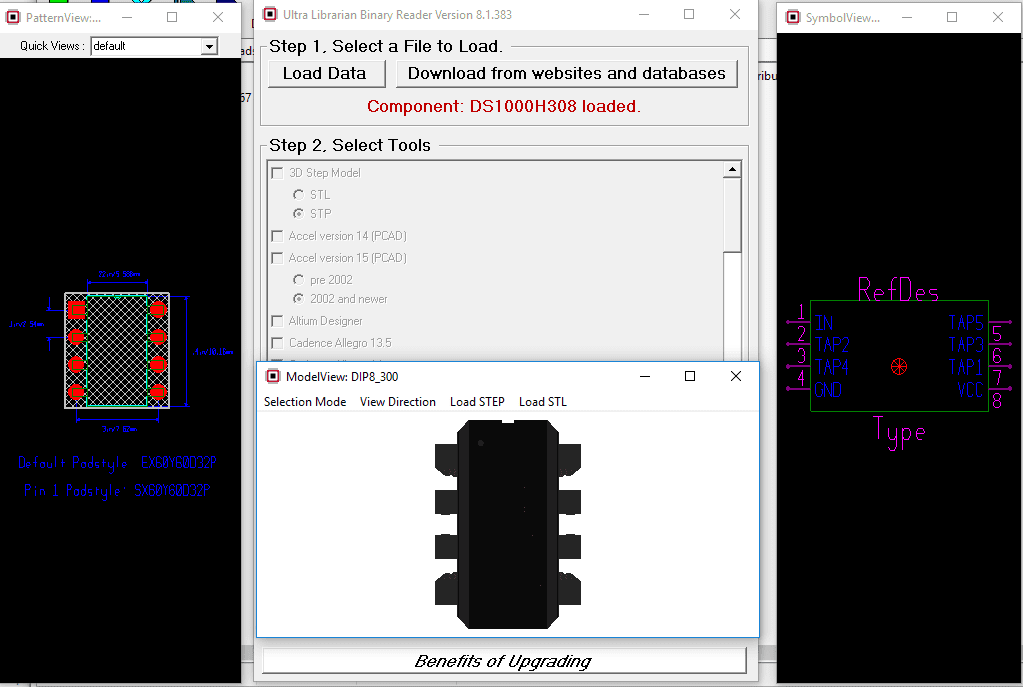
CREATE SYMBOLS, FOOTPRINTS, AND 3D MODELS FROM PRE-AUTHORED DATA

ULTRA LIBRARIAN FREE READER

Preview models prior to downloading

Choose from over 20 different CAD export options

Badhni kalan moga sex kand
CONVERT BXL FILES INTO YOUR PREFERRED CAD FORMAT

The free reader is a lite version of Ultra Librarian specifically designed to import vendor neutral CAD data (.bxl files) from manufacturers’ websites and then export symbols, footprints, and 3D models to specific CAD tool formats. The reader is a read-only tool and will not allow users to make any changes to the data. For symbols, footprints, and 3D model creation capabilities, use one of the Ultra Librarian Desktop Software options.

BXL FILES FROM YOUR FAVORITE IC MANUFACTURERS

Many of our IC partners offer BXL files for their components directly on their websites. Once you have obtained a BXL file it is quick and easy to convert to your preferred CAD format through our online BXL conversion tool.

Check out all manufacturers here.

EXPORT TO OVER 30 DIFFERENT CAD FORMATS

VENDOR NEUTRAL FILES

Accel EDA 14 & 15

  • DesignSpark
  • Mentor Graphics
  • BoardStation
  • Mentor Graphics Design Architect
  • Mentor Graphics Design
  • Expedition 99 and 2000
  • PCAD 2000, 2001, 2002, 2004, and 2006
  • STL
  • TARGET 3001!
  • View Logic ViewDraw
  • Zuken CadStar 3 and 4
  • Zuken CR-5000 and CR-8000

FREQUENTLY ASKED QUESTIONS

A .BXL file contains electronic data created by Ultra Librarian in a universal format and is used for distributing PCB information. .BXL files can be opened by the Ultra Librarian Free Reader and translated into your choice of 22 different CAD formats.

Ultra Librarian has partnered with major IC manufacturers to create electronic data representing their parts and are available to the public. Partners include Analog Devices, Texas Instruments, Microchip, Maxim, Silicon Labs, Renesas, Exar, and NXP.

Yes, you can use our Online Reader if you don’t want to download the Free Reader

Free Reader

"*" indicates required fields

Love marriages, where couples choose their own partners without family involvement, are becoming increasingly common in Badhni Kalan. This shift is influenced by popular culture, including Bollywood movies and TV shows, which often portray romantic love as a desirable and achievable goal.

An Exploration of Relationships and Romantic Storylines in Badhni Kalan, Moga

In recent years, the rise of social media has transformed the way people in Badhni Kalan interact and form relationships. Many young people use social media platforms to connect with others, including potential romantic partners. This has led to a shift towards more informal and casual courtship practices, with some couples even engaging in online dating.

Badhni Kalan, a small village in the Moga district of Punjab, India, is a rural setting that offers a unique backdrop for exploring relationships and romantic storylines. The village, like many others in rural India, is characterized by close-knit communities, traditional values, and a strong sense of social hierarchy. This paper aims to delve into the complexities of relationships and romantic storylines in Badhni Kalan, Moga, and examine how they intersect with cultural, social, and economic factors.

The relationships and romantic storylines in Badhni Kalan, Moga, are complex and multifaceted. They are shaped by a range of cultural, social, and economic factors, including traditional values, social media, and popular culture. While there are challenges and opportunities associated with these changes, it is clear that the way people form relationships and engage in romantic storylines is evolving.

Romantic relationships before marriage are generally frowned upon, and couples are expected to maintain a level of decorum and restraint in public. However, with the increasing influence of urban culture and social media, some young people in Badhni Kalan are beginning to challenge traditional norms and expectations.

However, traditional courtship practices, such as "meeting with a chaperone" (known as a " mahram" in Punjabi), are still prevalent. In this context, a young man and woman may meet with a chaperone, usually a family friend or relative, to get to know each other. This allows them to assess compatibility while maintaining social propriety.

Badhni Kalan, like many rural Punjabi villages, is deeply rooted in traditional values and customs. The community is predominantly Sikh, and the village is organized around a central gurudwara (Sikh temple). The gurudwara serves as a hub for social, cultural, and religious activities, and plays a significant role in shaping relationships and romantic storylines. In this context, relationships are often viewed through the lens of family honor, social status, and community expectations.

However, love marriages can also lead to tension and conflict, particularly if they are not approved by the families involved. In some cases, couples may face opposition from their families, leading to difficulties in maintaining their relationships.


the pcb design, assembly, and trends blog

RELATED CONTENT

Badhni Kalan Moga Sex Kand [verified] -

Love marriages, where couples choose their own partners without family involvement, are becoming increasingly common in Badhni Kalan. This shift is influenced by popular culture, including Bollywood movies and TV shows, which often portray romantic love as a desirable and achievable goal.

An Exploration of Relationships and Romantic Storylines in Badhni Kalan, Moga

In recent years, the rise of social media has transformed the way people in Badhni Kalan interact and form relationships. Many young people use social media platforms to connect with others, including potential romantic partners. This has led to a shift towards more informal and casual courtship practices, with some couples even engaging in online dating. Badhni kalan moga sex kand

Badhni Kalan, a small village in the Moga district of Punjab, India, is a rural setting that offers a unique backdrop for exploring relationships and romantic storylines. The village, like many others in rural India, is characterized by close-knit communities, traditional values, and a strong sense of social hierarchy. This paper aims to delve into the complexities of relationships and romantic storylines in Badhni Kalan, Moga, and examine how they intersect with cultural, social, and economic factors.

The relationships and romantic storylines in Badhni Kalan, Moga, are complex and multifaceted. They are shaped by a range of cultural, social, and economic factors, including traditional values, social media, and popular culture. While there are challenges and opportunities associated with these changes, it is clear that the way people form relationships and engage in romantic storylines is evolving. Love marriages, where couples choose their own partners

Romantic relationships before marriage are generally frowned upon, and couples are expected to maintain a level of decorum and restraint in public. However, with the increasing influence of urban culture and social media, some young people in Badhni Kalan are beginning to challenge traditional norms and expectations.

However, traditional courtship practices, such as "meeting with a chaperone" (known as a " mahram" in Punjabi), are still prevalent. In this context, a young man and woman may meet with a chaperone, usually a family friend or relative, to get to know each other. This allows them to assess compatibility while maintaining social propriety. Many young people use social media platforms to

Badhni Kalan, like many rural Punjabi villages, is deeply rooted in traditional values and customs. The community is predominantly Sikh, and the village is organized around a central gurudwara (Sikh temple). The gurudwara serves as a hub for social, cultural, and religious activities, and plays a significant role in shaping relationships and romantic storylines. In this context, relationships are often viewed through the lens of family honor, social status, and community expectations.

However, love marriages can also lead to tension and conflict, particularly if they are not approved by the families involved. In some cases, couples may face opposition from their families, leading to difficulties in maintaining their relationships.